How to Calculate Your Debt-Free Date (Snowball vs Avalanche)
Your debt-free date is the month your last balance hits zero. Once you have it, "someday" turns into an actual month. You can work it out with the calculator above, a spreadsheet, or pen and paper. Here's how the math works, so you know where the number comes from.
Step 1: List every debt
For each debt, write down three numbers from your latest statement:
- Current balance: what you owe today, not the original loan amount.
- APR: the annual interest rate. For a 0% promo, use 0, but note when it ends.
- Minimum payment: the smallest payment your lender accepts each month.
Include everything: credit cards, store cards, car loans, student loans, personal loans, medical bills, buy-now-pay-later plans and money owed to family. Most people leave the mortgage out of a debt payoff plan and handle it separately.
Step 2: Set your monthly debt budget
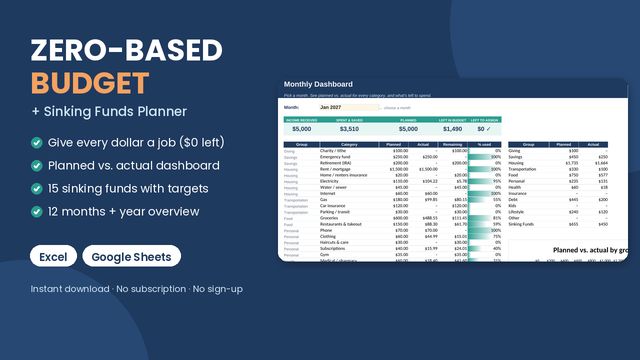
Add up all the minimum payments, then decide how much extra you can put toward debt each month. Your monthly debt budget is minimums + extra. The key rule is that this total stays the same until you're debt-free, even as individual debts disappear. If you aren't sure how much extra you can afford, a zero-based budget (every dollar of income assigned a job) is the fastest way to find it.
Step 3: Choose an order: snowball or avalanche
Debt snowball: smallest balance first
Pay minimums on everything and send every extra dollar to the debt with the smallest balance. When it's gone, its payment "rolls" into the next smallest. You knock out small debts early, and seeing a balance hit zero makes it easier to keep going.
Debt avalanche: highest interest rate first
Same process, but target the debt with the highest APR first. This usually costs the least interest, because the most expensive debt goes first. The downside: if your highest-rate debt is also a big one, the first payoff takes a while.
Step 4: Simulate month by month
This is the part a calculator does for you. For every month:
- Add one month of interest to each balance: balance × (APR ÷ 12).
- Pay the minimum on every debt (or the full balance, if it's smaller than the minimum).
- Take what's left of your monthly budget and put it on your target debt. If that pays it off, the remainder flows to the next debt in your order.
- Repeat until every balance is zero. Count the months: that's your debt-free date.
Total interest is all the interest added along the way. Run the same numbers with minimum payments only and you can see what the plan saves.
A worked example
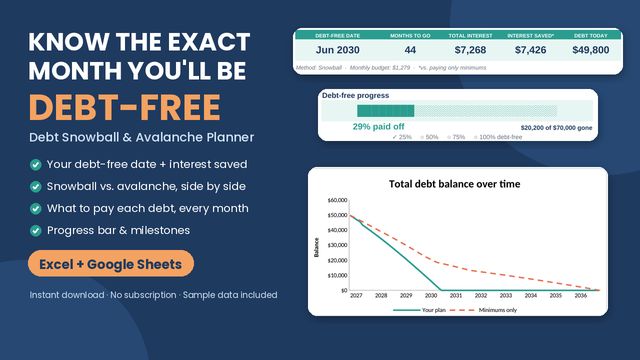
Click Load example in the calculator to see six typical debts: a $4,850 credit card at 24.99%, a $1,200 store card at 29.99%, a $14,300 car loan at 7.4%, a $22,600 student loan at 5.5%, a $650 medical bill at 0% and a $6,200 personal loan at 12.9%. That's $49,800 in total, with $1,079 of minimum payments.
With $200 extra per month ($1,279 total):
- Snowball: debt-free in 46 months, about $7,780 total interest.
- Avalanche: debt-free in 45 months, about $7,658 total interest.
- Minimum payments only: 121 months and about $14,694 in interest.
Either method saves roughly $7,000 and more than six years compared with paying minimums. The gap between snowball and avalanche here is only about $120, because the biggest balances have the lowest rates. Add a one-time $1,000 tax refund in month 6 and both methods finish in 44 months.
Step 5: Make the date move closer
- Raise the extra amount, even by $25. Try it in the calculator and watch the date change.
- Plan windfalls: tax refunds, bonuses and side income go straight to your target debt.
- Stop new debt: build small sinking funds for car repairs, gifts and annual bills so they don't land on a credit card.
- Ask for a lower rate on credit cards, or look at a 0% balance transfer if the fee and terms make sense for you.
- Check in monthly: compare your real balances to the plan so you know if you're ahead or behind.
Snowball or avalanche: how to decide
Have you started a payoff plan before and quit? Then the snowball's early wins are worth a lot. Paying off a small card in the first few months shows you the plan is working.
Is your highest-rate debt also one of your biggest? Then the avalanche usually saves noticeably more. Run both in the calculator to see the gap.
Is a rate about to change? A 0% promo ending, a variable-rate loan or a deferred-interest store card can be a reason to move that debt up the list.
You can also mix them: clear one or two tiny balances first, then go highest-rate-first for the rest. Our planner has a custom order option for this.
Doing it in a spreadsheet
You can build this yourself: one row per month, one column per debt, with formulas for interest, minimums and the extra payment. The tricky parts are rolling a payment forward when a debt is paid off partway through a month, and handling a minimum that's bigger than what's left on the balance. If you'd rather not build the formulas, a template does it and shows what to pay on each debt every month.
Common mistakes
- Lowering your payment when a debt is paid off. Rolling that payment into the next debt is what speeds the plan up.
- Minimums that don't cover interest. If a minimum is smaller than one month's interest, that balance grows. The calculator flags this.
- Forgetting promo end dates. A 0% card that jumps to 27% should probably move up your list.
- No buffer. Without a small emergency fund, one surprise bill can undo months of progress.
FAQ
How do I calculate my debt-free date?
List each debt's balance, APR and minimum, set a monthly debt budget, then simulate month by month: add interest (APR ÷ 12), pay minimums, send extra to your target debt and roll freed-up payments forward. The month the last balance reaches zero is your date.
Is the debt snowball or debt avalanche better?
Avalanche usually costs less interest; snowball gives faster early wins. When rates are similar the difference is often small, so compare both with your own numbers using the calculator above.
What happens when one debt is paid off?
Keep your total monthly payment the same. The freed-up payment rolls into the next debt, so payoff speeds up over time.
Why is my result different from my lender's?
This calculator estimates interest monthly (APR ÷ 12). Lenders may use daily interest, fees, promo rates or changing minimums, so treat it as a planning estimate.
How much extra should I pay each month?
Any amount helps. Try a few values above; an extra $50–$100 a month can move your date by months and cut total interest.